Camila: The Sans-Serif That Understands Modern Elegance
There is a specific kind of design challenge that requires a font to do two opposing things at once: it needs to command attention without shouting, and it needs to remain invisible enough to let the content breathe. Finding that balance is often the difference between a project that looks "homemade" and one that looks "heritage." This is the exact space where Camila thrives. It isn't just another entry in the endless catalog of sans-serif fonts; it is a carefully engineered tool for visual communication that brings a sense of chic minimalism to the table. For the designer, entrepreneur, or creative looking to inject a dose of refined sophistication into their work, Camila offers a solution that feels both contemporary and timeless.
The Anatomy of Quiet Confidence
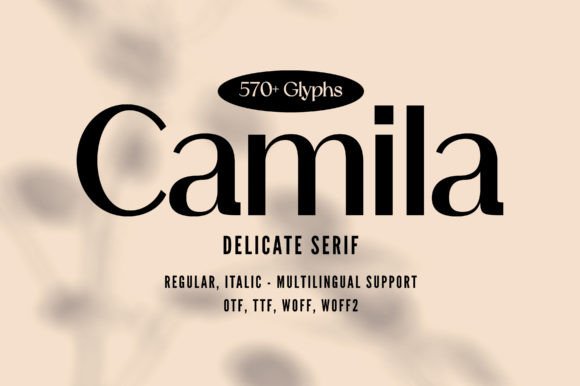
When you first look at the Camila typeface, the immediate impression is one of cleanliness. In a digital landscape often cluttered with loud, aggressive typography, Camila takes a step back. It embodies a "less is more" philosophy, but it achieves this through meticulous detailing rather than a lack of features. The letterforms are defined by their clean lines and elegant geometry. There is a distinct lack of unnecessary ornamentation here, which is precisely what gives the font its power.
Because it is a sans-serif, it inherently carries a modern, forward-thinking vibe. However, unlike some stark, industrial grotesque fonts that can feel cold or clinical, Camila possesses a subtle warmth. The curves are handled with a gentle touch, and the spacing—often the first thing to go wrong in cheap fonts—is expertly managed to ensure a rhythmic flow. This makes it a premium font choice for anyone who values the nuance of modern typography. It is the typographic equivalent of a perfectly tailored suit or a minimalist architectural interior; it proves that simplicity, when executed with high standards, is the ultimate form of sophistication.
Why 604 Glyphs Matter for Your Brand
For the uninitiated, a "glyph" might sound like technical jargon, but for anyone working in branding or international markets, it is the key to versatility. Camila comes loaded with over 604 beautifully designed glyphs. To put that into perspective, many standard fonts stop at the basic A-Z and 0-9. Camila goes far beyond that, offering a rich library of characters that allows for extensive customization.
This depth is crucial for a few reasons. First, it includes multi-lingual support. If you are a small business owner expanding into Europe, or a content creator working with a diverse audience, you cannot afford to have your typography break when you switch from English to Spanish, French, or German. Camila handles these linguistic nuances seamlessly, ensuring that your brand identity remains consistent and professional across borders. Second, the extensive glyph set often includes stylistic alternates and ligatures. This gives designers the creative freedom to tweak headlines and logos so that they don't look like a standard template. You can adjust the "personality" of the text to fit the specific mood of your project, ensuring that your visual communication is unique.
Practical Applications: Where Camila Shines
The versatility of a font is defined by where it can live. A script font might be beautiful on a wedding invitation but disastrous on a mobile app interface. Camila, however, is a chameleon. Its clean structure makes it a powerhouse for a wide variety of applications.
Branding and Logo Design: First impressions are visual. When designing a logo, you need a typeface that is legible at both massive billboard sizes and tiny favicon dimensions. Camila’s geometric clarity ensures that your brand name remains recognizable whether it is stamped on a business card or displayed on a website header. It pairs exceptionally well with both serif fonts for contrast and other sans-serifs for a uniform look.
Digital Presence and Web Design: Readability is the currency of the web. If users struggle to read your blog posts or navigate your menu, they leave. Camila functions beautifully as a web font. Its open letterforms and balanced x-heights make it easy on the eyes for long-form reading, reducing eye strain for your audience. It is an excellent choice for UI (User Interface) design, ensuring that buttons, headers, and body text look cohesive and intuitive.
Packaging and Editorial Layouts: For those in the physical product space, packaging design relies heavily on hierarchy. You need the product name to pop, but the ingredients list needs to be legible. Camila offers enough weight variations to create this hierarchy naturally. Similarly, in editorial design—such as magazines, lookbooks, or digital PDFs—Camila provides the breathing room necessary for layouts that feel airy and expensive.
Social Media and Marketing Assets: In the fast-scroll environment of Instagram, TikTok, or Pinterest, clarity is speed. You have milliseconds to convey a message. Display fonts are great for hooking attention, but Camila is the reliable workhorse that delivers the actual information. It is perfect for quote graphics, infographics, and call-to-action overlays where the message needs to be understood instantly.
Strategic Typography: Pairing and Usage
Choosing a font is rarely about the font alone; it is about how it interacts with other elements on the page. When working with Camila, consider the concept of font pairing. Because Camila is a sans-serif, it naturally complements serif typefaces. Try using a classic serif for your main headings to evoke a sense of tradition and authority, then use Camila for your subheadings and body text to keep the layout feeling fresh and modern. This contrast creates a visual dynamic that guides the reader's eye naturally down the page.
However, don't be afraid to use Camila as the primary hero font. If your brand identity is rooted in minimalism, luxury, or tech, Camila can carry the entire load. Use the heavier weights for impactful headers and the lighter weights for elegant, spaced-out subtext. One practical tip for designers: always test your typography on multiple devices. A font that looks perfect on a 27-inch monitor might feel cramped on a mobile screen. Fortunately, Camila’s design scales well, but testing ensures your professional presentation is flawless.
Commercial Considerations and Licensing
For entrepreneurs and freelancers, the legal side of design assets is just as important as the aesthetic side. When you invest in a creative font like Camila, you are often securing a commercial license. This is a critical distinction from free fonts found on the web, which often come with murky licensing terms that can put your business at risk later.
A commercial font license typically allows you to use the typeface in projects that generate revenue—whether that is a client's logo, a merchandise line, or a digital product you sell. It provides peace of mind. You know that your brand identity is built on solid legal ground. Before finalizing any project, it is always wise to review the specific license agreement of the font file to ensure it covers your intended use, whether that is print-on-demand, app development, or standard client work.
Elevating the Everyday
Ultimately, the tools we choose say a lot about our standards. Selecting a typeface like Camila signals to your audience that you care about the details. It moves a design away from the generic and toward the curated. Whether you are a hobbyist creating scrapbooks, a marketer drafting a high-stakes pitch deck, or a designer building a global brand, the typography you choose is the voice of your visual story.
Camila offers that rare combination of beauty and utility. It doesn't demand to be the center of attention, yet it elevates everything it touches. It is a tool that respects the content it displays, allowing your message to shine through with clarity and grace. In a world that is often too noisy, Camila offers a moment of visual calm—a sophisticated, chic, and endlessly versatile foundation for your next creative endeavor.